Als mein Vater ein Busch wurde und ich meinen Namen verlor
Credits
Text Joke van Leeuwen, translated from Dutch by Hanni Ehlers, in a version of Susanne Koschig
Direction Susanne Koschig
Set, Puppet & Costumes Kathrin Sellin
Translation & Supertitels Anna Galt
With Kathrin Blüchert
Age 8 years and older
Duration 60 minutes
Time & Location
- 04/26/17 11:00 am
THEATER AN DER PARKAUE im Prater
followed by Perspektivwechsel - post-performance discussion with the KinderTheaterBeirat of GRIPS Theater - 04/26/17 3:00 pm
THEATER AN DER PARKAUE im Prater - 04/27/17 10:00 am
THEATER AN DER PARKAUE im Prater - 04/27/17 5:00 pm
THEATER AN DER PARKAUE im Prater - 04/28/17 10:00 am
THEATER AN DER PARKAUE im Prater
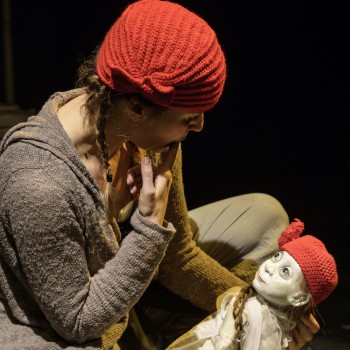
Until war broke out in her country, Toda, whose name was changed because it was “too hard to pronounce" in her new home, lived with her father. But then he has to leave in order to protect one side from the other. He has to learn how to become a bush in order to camouflage himself. And suddenly nothing is normal anymore. When things get too dangerous, Grandma sends Toda off on a journey. She has to cross the border to the country next door by herself to join her mother. And she has absolutely no idea what a border looks like. On her adventurous journey, Toda meets a lot of different people: a money-hungry smuggler, a stressed out teacher, kids that are meant to give their toys away and a commander who cannot command anything at all.
In Susanne Koschig’s production, storytelling, drawing with chalk, acting, puppetry and shadow puppets all come together. She creates an intimate framework in which the audience is practically sitting on the stage, can help shape the events on stage and thus become protagonists themselves. Classic fairy tale elements are combined in this moving story of escape in which the now adult Toda tells the story of war and loss clearly and calmly. She tells the tale of slowly becoming accustomed to another culture and of learning a foreign language. Kathrin Blüchert’s complex performance of this strong young hero invites the audience to cheer her on and sympathize with her.
Susanne Koschig studied literature and theater studies at HU Berlin and has been a dramaturg at Theater Waidspeicher since 2014. Prior to this, she worked at the University of Erfurt in the field of children’s literature research. Als mein Vater ein Busch wurde und ich meinen Namen verlor is her debut production as a director at Waidspeicher.
Theater Waidspeicher in Erfurt is a renowned German ensemble puppet theater. It has gone on tour throughout Europe, the USA, Canada, Mexico, Taiwan, Israel and Russia. It is the host of the international puppet theater festival Synergura.
The production was invited to perform a guest performance in 2016 at the Federal State Parliament of Thuringia within the framework of SHUK ACHAVA, a cooperation event between the ACHAVA festival in Thuringia and the Federal State Parliament of Thuringia.
Vote
Joke van Leeuwen’s children’s book about the experiences of little Toda, who is supposed to be brought to safety from the approaching war by retaining the services of an expensive coyote, or human smuggler, was translated from Dutch to German in 2012 and has been adapted multiple times for a variety of children's and youth theaters. The most convincing production of them all is the one by Theater Waidspeicher in Erfurt.
As a grown woman, Toda reports on the experiences of her escape as a child. Chalk, pieces of paper, a box, and a mop are tools she uses to tell this story of a shocking uprooting and loss of experience playfully, in the truest sense of the word. The specific aspects of the always current refugee situation is interwoven with fairy tale-like elements. As a result, the characters that Toda encounters are generally typecast into the realm of the fantastic. The situations that she has to live through seem like tests that the heroine of the fairy tale must pass in order to complete her task. What remains unmistakable, however, is that this is much less about development and maturation than about simple survival.
The narrative tone, however, remains light, laconic and comic moments are also found often, even in threatening situations. The small form, modest in the tools it applies, that the director Susanne Koschig employs to bring the story on stage makes full use of the opportunity to bring the young audience members directly into the events. A sense of attachment is formed through the device of having the children incorporated into the creation of the fictitious starting location of the story by drawing their ideas about it on the floor of the stage. A strong signal is also given by the inexorable wiping away of these drawings. The production gives the children the option of participating in the events of the story multiple times, creating a direct link to the reality of their own lives. In doing so, they try out something that one could call empathy. This is something that is urgently needed at the moment.
Anke Meyer