Kindheit
Ein Theaterstück mit Texten von David Lindemann und Ensemble
Credits
Direction Stephan Weiland
Choreography Gary Joplin
Dramaturgy Sonja Karadza
Music Carlo Philipp Thomsen
Light Bernhard Ott, Felix Kremser
Set Bernhard Ott (director), Aaron Andersen, Felix Kremser, Manfred Loritz, Jörg Schroth
Costumes Sabine Steinort
Choreography Assistance Salim Ben Mammar
Direction Assistance Juliane Wilke
Costumes Assistance Gisi Kinsky
Translation & Supertitels Kate Mcnaughton
With Dominik Knapp, Dietmar Kohn, Salim Ben Mammar, Daniela Mohr, Renate Obermaier, Nadine Werner
Age 10 years and older
Duration 95 minutes
Time & Location
- 04/28/17 7:00 pm
THEATER AN DER PARKAUE / Bühne 3
accessible - 04/29/17 10:00 am
THEATER AN DER PARKAUE / Bühne 3
accessible - 04/29/17 8:00 pm
THEATER AN DER PARKAUE / Bühne 3
accessible
Supporters
Funded by: The Ministry for Science, Research and Art of Baden-Wuerttemberg
Some of them have buried a treasure and then can’t ever find it again. Others puke in the car. One tells his mom everything. The worst ones meet at the pond to kill frogs. There is also one who steals. Most of them always know where the limit is, but a few don't. All of them belong to this exclusive little clique called childhood. No other person is both so close and so completely another person as the child we all once were. Remembering also means inventing. Six people get together in a backyard and are pretty sure that they have long since grown up and aren’t part of this clique anymore. They try to approach the child that they once were. The child that is so close to them and yet so far at the same time. Erich Kästner once said: It’s never too late for a happy childhood.
Director Stephan Weiland and choreographer Gary Joplin have recollected their childhood with six performers from different generations. Autobiographical and literary material was used as the starting point for the development of this production. Writer David Lindemann contrasted the improvisation and conversations of the actors with his own literary flourishes.
Founded as an independent children’s and youth theater in 1973, Theater im Marienbad has performed in a pool built in the art nouveau style since 1989 and sees itself as an independent ensemble theater. Its productions are intended for children, young people and adults.
Stephan Weiland is a freelance director in Berlin. He worked for many years as a dramaturg at Theater im Marienbad and directs productions there on a regular basis. Kindheit is his second collaboration with choreographer Gary Joplin, who is based in Freiburg.
The production Kindheit by Theater im Marienbad was invited to the international children’s and youth theater festival Schöne Aussicht in Stuttgart in 2016.
Vote
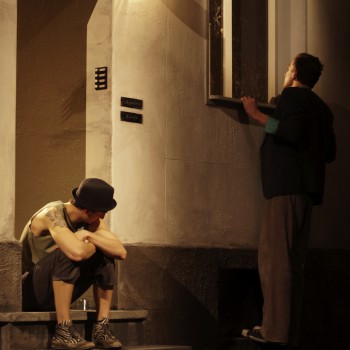
If one is used to postdramatic performance, then one will be rather irritated when they enter the auditorium of Theater im Marienbad. The hyper realistic stage design of Kindheit presents a backyard that seems to have fallen out of time, including dirty glass windows. Six adult actors from different generations have assembled in this backyard. Memories from childhood are shared in a collage-like manner in a text based on improvisation and refined by playwright David Lindemann. With this text-based and performative access, the ensemble bypasses a point often discussed in the meetings of the festival curators: the presentation of children by adult actors in children’s theaters. In Kindheit, however, it is not the child that is portrayed by the actors, but instead the memory of the child. In the production, childhood emerges as a time bubble in which one is dependent upon information and impressions from the outside and in which one interprets these in one’s own world, marked by imagination.
The memories go back deeply into the 20th century and while they vary in terms of childrearing methods and taboos between the generations, they do not in terms of the fears, euphoria or other emotions that they trigger in those remembering. The backyard stands for a variety of times and places, at times being a specific space and at times an abstract one. The journeys through time, existing both in terms of content and in terms of choreography, into the childhood memories of the six actors transform individual stories into collective experiences. As an audience member, one identifies with specific actions or time references, as well as with the sensory stimuli they trigger. Memories that are 50 years old become topical for children watching today.
Kindheit is the attempt of an ensemble that has existed for 43 years to explore the genre of children’s theater anew despite its great wealth of expertise. It is also an attempt to redefine the role of the playwright in age of devised work and to combine biographical work with the development of play scenarios.
Mijke Harmsen