Eins zu Eins
Ein Tanzduett
Credits
Concept, Choreography & Set Birgit Freitag
Set & Costumes Léa Dietrich
Music Michael Henn
Dramaturgy Sabrina Bohl
Light Tim Schulten
Direction Assistance Laura Brust
Sound Ewa Gorecki
With Mika Nowotny, Walter Schmuck
Age 10 years and older
Duration 60 minutes
Time & Location
- 04/25/17 6:30 pm
THEATER AN DER PARKAUE / Bühne 3
accessible - 04/26/17 5:00 pm
THEATER AN DER PARKAUE / Bühne 3
accessible - 04/27/17 3:00 pm
THEATER AN DER PARKAUE / Bühne 3
accessible
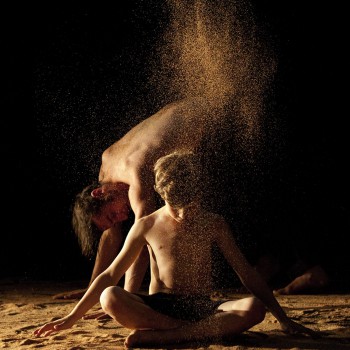
Stages make us stop taking our bodies for granted. Sweat, tension, scars, effort, lightness – everything that surrounds us on a daily basis, which makes us up and fades away within our physical everyday life can be seen, presented and questioned anew here. Mika is 11 years old and Walter is 32. There are 21 years, 2 months and 38 centimeters between them. On stage, they investigate together what makes up their bodies, how they change and how they are perceived. They explore their mutual trust and strengths, examine their desires, similarities and dissimilarities. What age does our body announce to the world and is this announcement true? Does our external appearance seem childish or adult or do we only represent attributes? In this dance-like encounter, not only are two bodies with different experiences facing each other, there are also two types of movement, marked by environment and personality. Mika and Walter set off on a search for the different concepts of masculinity, experiences and levels of development which are inscribed in their bodies.
With Eins zu Eins, Birgit Freitag has choreographed a duet between two people who are not dancers and can thus freely follow the trails of their respective and shared movements. They do so with no trace of shyness and with a curiosity which is contagious. One examines a body that he may have one day, the other examines a body he may have once had. What will change, what has changed?
Birgit Freitag works as a freelance choreographer. She founded her own label for interdisciplinary projects in 2000, every friday | dance production. She has created solos and duets since 2009 in an artistic genre somewhere between movement portraiture and biographical fiction. She has worked as a choreographer at Theater Bremen since 2012. Eins zu Eins is her first full-length production for JUNGES.THEATERBREMEN.
Vote
It is, at first, as simple a constellation as possible: a man, a boy, a stage. Walter is an actor and in his early thirties. Mika is a student and 20 years younger than Walter. Between the two of them, so to speak, as a space for resonance as well as for play is the discrepancy between their respective times on the planet and life experiences, the differing premises, the differing desires, dreams, problems. And, not least of all: the differing types of body language as well as body perception. One’s own, as well as that of the other.
Each is their own world, one could say. Child and adult. And yet between them is everything but unfamiliarity – even if there is sometimes a friendly foreignness in the mutual examination and discovery. As if one were searching in the other for what one could become, what one once was and what one is. What is lost and what should be saved. Who am I really and how am I perceived?
Eins zu Eins circles around this with a series of scenes for which the genre description “dance duet” is, in fact, too narrow. And this is not only because neither of the two protagonists is a professional dancer. In fact, this clearly contributes to allowing this performance to become a cleverly unpretentious and simultaneously hypnotic balancing act. One which walks the tightrope between attribution and authenticity, between childhood and adulthood, between irony and melancholy. And one in which music, dialogue and movement sequences actually come together into something which earns the name “unified". Which, in turn, is anything but something to be taken for granted and “as simple as possible”. And which comes across in a very touching manner without being obtrusive. After all, the way in which Mika and Walter seem to remain themselves the entire time they are on stage, entirely Eins zu Eins, or one to one, attests to that trust in each other and attention for each other which is then transferred to the audience, whether they are grownups or not. And from which one can certainly learn something.
Steffen Georgi